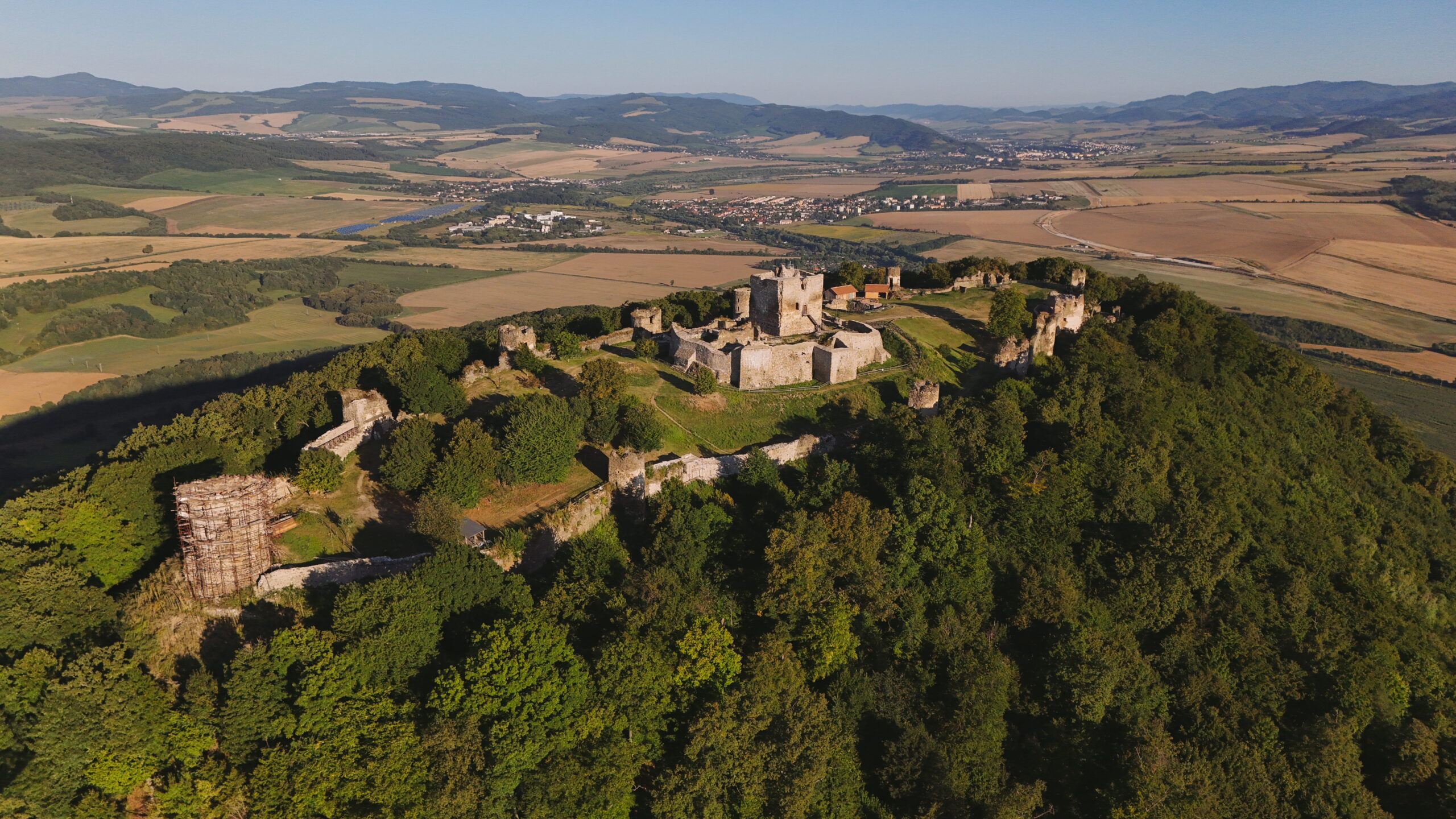
The first mention of the village Pečovská Nová Ves dates back to 1319 (Wyfalu). This historically important village was already the seat of noblemen in the Middle Ages, but it was not until the beginning of the modern period that it became the centre of an estate, which necessitated the construction of a landowner's residence. Until 1322 it was a royal property, then it and its surroundings were owned by the nobleman Mičko, who built his mansion high in the Čergov Mountains. Through marriages, other families who occupied manor houses and curonias in the village, be it the Pécha, Mariássy or Bornemisz families, came to Pečovská Nová Ves. Thanks to them, Pečovská Nová Ves is extremely rich in monuments and historical buildings. In addition to the Baroque church, the Classicist synagogue and the chapel, there are more than 10 mansions and manor houses, which can be rivalled in Slovakia only by the municipalities of Liptovský Ján or Brezovica. Such a concentration of monuments is unique for rural areas.
The classical palace was built in the first half of the 19th century in the classical style. The building was built in the shape of the letter „L“, as evidenced by the condition plotted on the historical cadastral map of 1869. Benjamin Péchy started to build the curia for his son. However, when his son died suddenly in Vienna, the construction was stopped. The building was completed only by his daughter (wife of Denes Pongracz). After the decision to move to Liptov, the cottage was sold to Lajos Bornemisz. He in turn sold the building to Elemer Peci - for 10 thousand florins.
The courtyard is single storey, the north wing is two storeys and there is a basement only under the north wing. On either side of the central, central entrance hall are mirrored four-space layouts, which are communicatively connected by a corridor NE tract. The curio wing is transversely two-bayed with respect to the street. The space of the entrance hall is roofed with a low compressed plate vault. The other rooms of the curio house also have vaulted plaque or flat ceilings. During the last restoration, an entrance portico was added. Today, the park in front of the municipal office of the cure on the original site, in its original shape and size, thus restoring the original covered entrance. The supporting masonry - the pillars of the portico are made of solid brick, the arched passages between the pillars are made of reinforced concrete, the horizontal supporting structure is made of a reinforced concrete slab. The balustrade is formed by sandstone busters, a profiled slab at the bottom and a profiled parapet. The portico pillars are decorated with simple, profiled cornices at the arched openings. The portico pillars are lined in the plinth with sandstone slabs with a mountainous ending with a plinth cornice. The cornices have triangular gables flanked by moulded cornices. There is a straight moulded cornice above the window openings of the elevations and a pair of vent window openings above. The main entrance portico is also terminated at the top by a triangular gable. The roof of the building is hipped. To the west of the building is an area of original parkland with new landscaping. Architecturally and in terms of layout, similar curios from the same period can be found in nearby Uzovské Šalgov and Hermanovce. For a very long time, the mansion retained its original appearance, including the landscaping and the farmyard.
Until 1945 the building served the original owners and the original purpose (residential). After the Second World War it was confiscated. Between 1945 and 1950 it was used as a warehouse, after 1950 it was adapted for the purposes of a kindergarten, and between 1961 and 1962 it was adapted for the needs of a nine-year primary school, a library and a cinema. The north wing was adapted for the cinema, in which all the internal partitions were removed and an additional space was added to the north wing of the building (the stage). A comprehensive replacement of window infills, partial door infills, roof and floors was carried out. In 1979 - 1980 the building was reconstructed for the purposes of Pleta VD Prešov. Since 2002, the building has been undergoing a comprehensive renovation and extension for the purpose of establishing the Municipal Office of the municipality.
Source/Photo: village Pečovská Nová Ves - travels through history