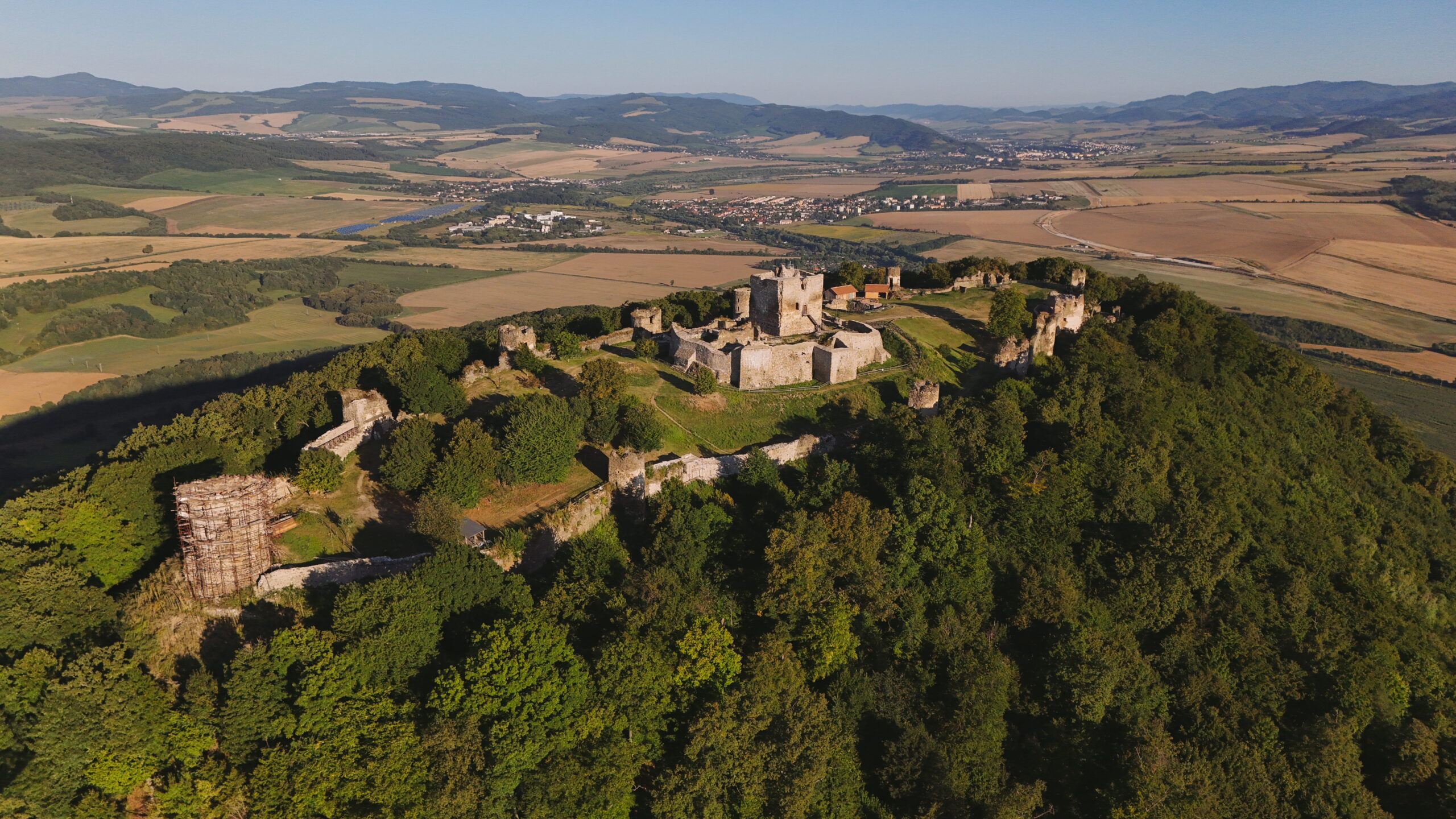
The first mention of the village Pečovská Nová Ves dates back to 1319 (Wyfalu). This historically important village was already the seat of noblemen in the Middle Ages, but it was not until the beginning of the modern period that it became the centre of an estate, which necessitated the construction of a landowner's residence. Until 1322 it was a royal property, then it and its surroundings were owned by the nobleman Mičko, who built his mansion high in the Čergov Mountains. Through marriages, other families who occupied manor houses and curonias in the village, be it the Pécha, Mariássy or Bornemisz families, came to Pečovská Nová Ves. Thanks to them, Pečovská Nová Ves is extremely rich in monuments and historical buildings. In addition to the Baroque church, the Classicist synagogue and the chapel, there are more than 10 mansions and manor houses, which can be rivalled in Slovakia only by the municipalities of Liptovský Ján or Brezovica. Such a concentration of monuments is unique for rural areas.
In the surroundings of a nice green side street stands a ground-floor baroque manor house from the second half of the 18th century (the last owner was Ján Mariássy) - Mariášiovský manor house.
It is assumed that the manor house was built shortly after the construction of the nearby St. Andrew's Church (completed in 1757). Some craftsmen also worked on the manor house in question (especially the stucco decorations are similar). It is known that the manor house was owned by Tomáš Pechy in 1869. The Péchy family owned the manor until the interwar period, after which it was bought by the Bornemisz family. However, after Lajos Bornemisz, the building was inherited by his daughter Ilona Bornemisz-Mariassy and through her the property came into the possession of the Mariassy family, after whom the building is still named. In the second half of the 19th century, only modifications related to the change of the heating system were carried out, the sanitary facilities were modified, a staircase was built in front of the main entrance and the window panes were replaced. The most well-known structural interventions were carried out in the 20th century with a new entrance on the south-west façade and a terrace built in front of it - facing the park. Some of the window panes on the side facades were replaced with Art Nouveau panes. After the Second World War, the roof was changed, new chimney stacks were built on the south-east side, the staircase space was closed and the staircase to the attic on the side of the entrance hall was closed.
The ground-floor manor house has a rectangular plan and is fully basemented. The individual rooms of the basement are vaulted with vaulted vaults with contact gallows. The space of the south-western part is designed as a large, open space, where the vaults rest on four massive pillars with inter-vaulted bands. The floor in this space is made of ceramic tiles, whereas in the previous rooms it is only of rammed earth. The ground floor forms a structural three-bay transom. The individual rooms are vaulted with plaques without vaulted bands, only the space to the east is covered by unequally wide vaulted bays and roll vaults with dadoes. The vaults of the rooms on the ground floor are provided with stucco decoration. Richly Baroque decorated stucco mirrors are mainly in the original representation hall, but also in the entrance hall. The vast majority of the entrance openings have even preserved the original wooden panelling (Baroque) and also several primary infills have been preserved - Baroque coffered doors with original fittings. The attic was originally built as partly residential, the rooms are covered with weeping vaults. The impressions on the gables in the attic interior demonstrate the shape of the manor's earlier mansard-type roof. This manor house has the most decorated facades of all the noble mansions in the village. The exterior is articulated by a moulded crown cornice and a simple projecting plinth. The vertical façades are articulated by pilasters with plain shafts, in the lower part by footings and under the cornice with capitals, with rich stucco decoration (stylized floral decoration). The main façade is east facing with an entrance in the centre, formed by a stone auricular portal, framed by a narrow moulding with a drop and a main arch. The entrance is approached by a straight flight of single steps with stone steps and brick balustrade with a full parapet. Window openings have stone moulded eared eaves with moulded moulding and arch in straight lintel, moulded window cornice and externally set with wrought iron, folded grille with diagonal bars. The infill consists of timber, double-hung, four-light, six-paned windows opening to the interior. The parapets are decorated with stucco decoration with a chabraka motif.
Although this manor house is not one of the oldest buildings, it is definitely the most authentically preserved in the village, not only in terms of its construction (it looks almost as it did at the time of its construction), but also including many architectural and, above all, craftsmanship details. Its grounds are partly enclosed by a historic stone enclosure wall. In the second half of the 19th century, a park of 1.5 ha was also established next to the manor house. The natural-landscaped Mariáši Park with its historic greenery was landscaped in the 1970s.
There were also two other buildings in the village, which later disappeared. The late Renaissance manor house from the first third of the 17th century (the last owner Antal Péchy) was built in the garden near the chapel of St. John. A late Renaissance manor house from the first third of the 17th century (the last owner was Ferenc Péchy's wife) stood near the present municipal office building. Both manor houses were damaged by artillery in 1919 and gradually disappeared.
Source: village Pečovská Nová ves - travels through history
Photo: village Pečovská Nová Ves /Jozef Kotulič