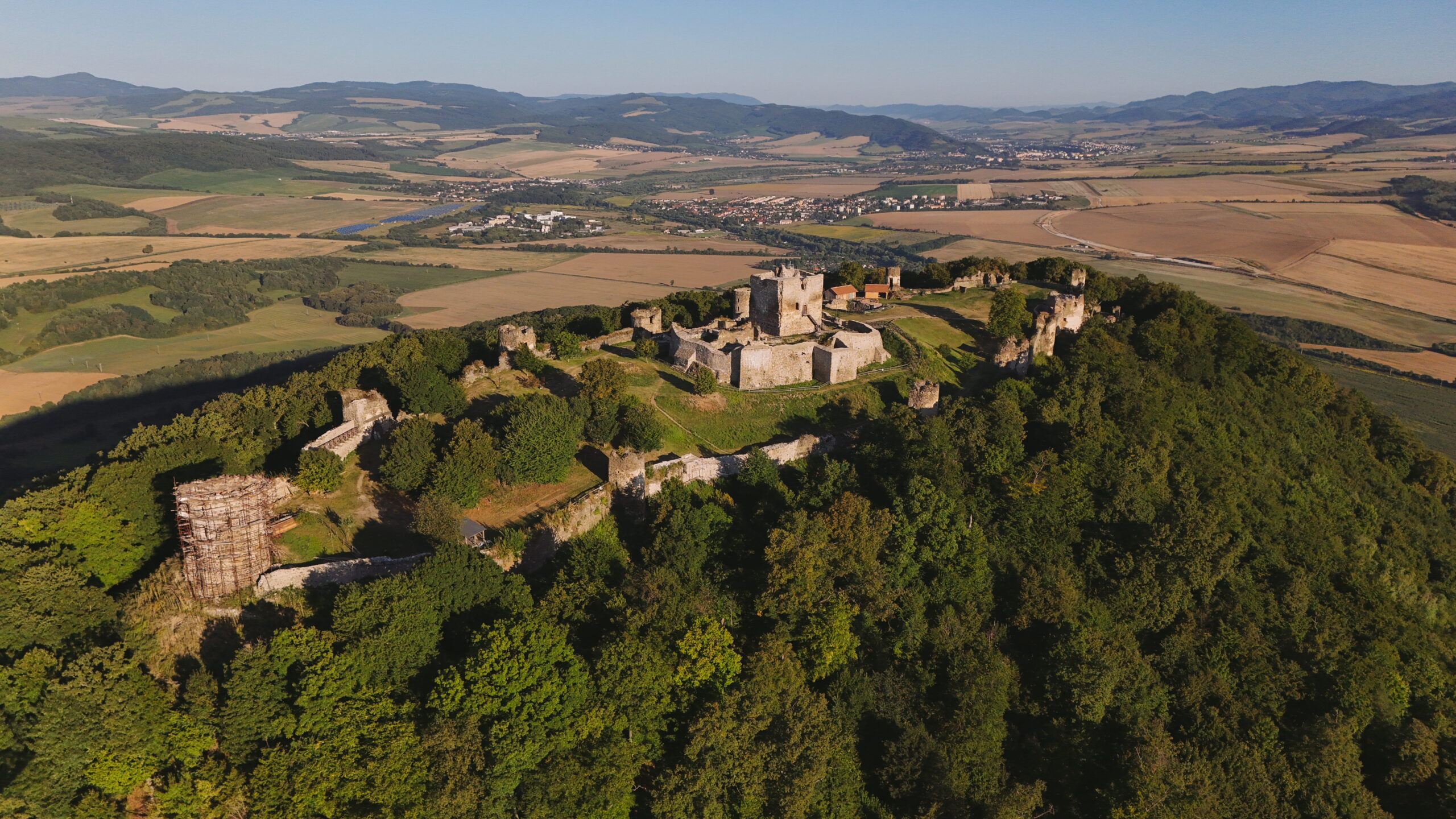
The first mention of the village Pečovská Nová Ves dates back to 1319 (Wyfalu). This historically important village was already the seat of noblemen in the Middle Ages, but it was not until the beginning of the modern period that it became the centre of an estate, which necessitated the construction of a landowner's residence. Until 1322 it was a royal property, then it and its surroundings were owned by the nobleman Mičko, who built his mansion high in the Čergov Mountains. Through marriages, other families who occupied manor houses and curonias in the village, be it the Pécha, Mariássy or Bornemisz families, came to Pečovská Nová Ves. Thanks to them, Pečovská Nová Ves is extremely rich in monuments and historical buildings. In addition to the Baroque church, the Classicist synagogue and the chapel, there are more than 10 mansions and manor houses, which can be rivalled in Slovakia only by the municipalities of Liptovský Ján or Brezovica. Such a concentration of monuments is unique for rural areas.
The manor house "Bornemisza" represents a more modern form of a mansion in the form of a villa, which was built by rebuilding an older nobleman's mansion. There is also specific information that this older building of the Pécs family (tentatively dated to the 18th century according to the details of the ground floor) was added a storey at the end of the 19th century and altered by Sigismund Pécs. It was built on an older foundation with co-opted vaulted parts of the ground floor, for convenience, which he had decorated with rather rich stucco decoration on the facades. This created 14 rooms, a large staircase and a terrace. The building was surrounded by a large park. „The manor house “was named after the later owner Bornemisz, as it came from the Peči family estates (through Maria Peči and her husband Istvan Bornemisz) to this family. However, only briefly, because after the Second World War the building was confiscated and used for various storage and residential purposes. Thanks to a minimum of further building interventions, it has been preserved to this day in the form in which it was rebuilt at the end of the 19th century. The building, with a rectangular plan, has ground-floor rooms vaulted with Prussian vaults on the waist, with stucco decoration at the top. The space is illuminated by windows with segmental arches and sloping lining. The arches and their decoration, as well as the design of the shapes of the openings, are typical of the Baroque period (18th century). Thus, the building was built roughly like the nearby Mariasiai manor house. A wide staircase in the middle of the building, which was built after the addition of the curia, leads to the first floor. The superstructure was made of solid burnt brick, the rooms were covered with already flat wooden but plastered ceilings and a new hipped roof. The appearance of the exterior was unified - the older ground floor received (as the first floor) decoration in the form of lozenges, cornices, chambranes and pediments around the windows and entrances. A northern bay with a gable was built, where the family coat of arms in stucco was placed. A brick terrace was built on the south side. A number of craft details (windows, doors, tiles, railings) have also survived to the present day. The grounds of the manor house consisted of a well-kept park with beautiful trees.
The last owner of the manor was Stefan Bornemisz - Istvan Bornemisz, the son of Maria Péchy, daughter of Zsigmond Péchy, the chief governor of Abov-Turnian. He was born on 24.11.1917 in Budapest, died on 15.11.2006 in Pečovská Nová Ves and was the son of the royal chamberlain Istvan Bornemisza. After the dissolution of the monarchy, his family lived in Pečovská Nová Ves, where they owned three manor houses and managed their extensive estate. Stefan's father was taken to the USSR to the Gulag, from where he never returned. Štefan studied law and loved cavalry. In 1955 he founded a riding troop in Poprad, with which he participated in several films of Slovak as well as foreign provinces such as Jánošík, Vivat Beňovský. After 1989 he devoted himself to charity and for his services he was ordained a Knight of the Order of Maltészke on 20 January 1995, as the first citizen of Slovakia. Štefan Bornemisza was a man with artistic inclinations, be it literary, sculptural, painterly, but also carving.
Source/ photo village Pečovská Nová Ves - wanderings through history